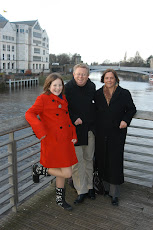
Hi there. Sarah here again. No, this is not turning in to a takeover bid, it's just that Wonder Boy has been making life even more exciting over the last couple of days to the extent that he is once again tucked up in a hospital bed.
As Dave himself has already mentioned, he has been experiencing some bouts of severe breathlessness which have been very frightening - he says that he has felt as if he is suffocating at times. Yesterday morning he had two bouts and went to see our GP late morning to have this checked out. On examination the doctor said that Dave's right lung sounded dull as if it contained some fluid and that he needed to be admitted to hospital immediately. On hearing this Dave called me home from work and we reported to A and E as instructed. We were told on arrival that there were no spare beds in the hospital and no spare bays in A and E so we would need to wait in the Waiting Room. The medical registrar would come down and see us at some point but there was a likely wait of approximately 4 hours. I was quite upset at this as to be honest it seems ridiculous that a terminally ill patient has to wait to be seen in amongst all the minor injuries dealt with in a Casualty department - especially when they are as poorly as Dave. In the event I got our Macmillan nurse, Caroline, on the case and she managed to talk to a few contacts at the hospital who managed to persuade the Bed Manager to get Dave a side room on the surgical ward where he first went after his original operation. This process took 5 hours but the end result was a good one and I was even more pleased with the result today when I found out that the reason the hospital was so busy was that they are on a "red alert" with 4 wards closed due to the d and v bug norovirus (or whatever it's called). Dave is very pleased to be on Ward 16 as all the nurses still remember him and he gets well and truly pampered even to the extent of them searching the biscuit tin to find him custard creams and making him copious amounts of toast when his ailing appetite does not feel up to tackling the hospital food.
The experience of A and E was like being in an episode of Holby City without the glamour. The poor junior doctor who dealt with us looked as if he had already worked 200 hours this week and was wearing two bleeps and two mobile phones which bleeped and rang constantly. He took an xray which showed a shadow covering a third of Dave's right lung. This was quite alarming for us as the secondary cancers in Dave's lungs which were found last year were in his left lung. The junior doctor discussed the xray with the consultant and they decided to order a CT scan and an ultrasound scan for today to determine what the shadow was. Three possible theories were discussed: fluid on the lung which could possibly be drained off but might reoccur, an embolism (blood clot) possibly treatable or the worst option, a large mass of tumour. As Dave has not had any kind of scan for a year now the thought of how much the tumours may have grown is quite frightening.
The scans have been done today but we have not yet seen a doctor, however from what the ultrasound technician said tonight it seems it may be the fluid option which would, in a way, be a relief as something should be able to be done. In the meantime while we wait for the official results Dave is relaxing as much as he can and has been given oxygen. He slept with the oxygen thingy up his nose last night and slept really well as in the last few days he was starting to get frightened of going to sleep in case he had one of these nasty episodes. It seems as though we may need to have oxygen at home in the future.
Things are much calmer with all of us today. Yesterday was a very upsetting day which ended with Dave, Emma and I all in tears in his hospital room. It is at these sorts of times that we really feel the pain of everything that is happening to our happy little unit and there is absolutely nothing we can do to get control of what is going on. The evening was made all the more traumatic by the fact that a man in one of the other side rooms is dying and has refused all pain relief, so he was screaming with pain most of the time and when he wasn't doing that he was being abusive to the nursing staff. Having seen with Dave's situation how painful pelvic disease can be, I find it very hard to understand any valid reason why anyone would refuse pain relief and die in such a state of distress. I wonder if her realises how much distress respecting his wishes is causing the medical and nursing staff and the other patients.
We will obviously keep you avid blog followers up to date as to what happens with Dave (I've had numerous texts and emails asking what is happening......). I'm sure he will post again soon.
Thursday, 11 December 2008

Tuesday, 9 December 2008
Home Again
I arrived at the hospital to be told I was definitely staying in over night and there was no "possibly" about it. I'd foolishly assumed when I'd been told by the appointment's secretary to bring an overnight bag "just in case", there was some doubt about it! It is the kind of poor communication that can create an expectation which, when its thwarted, leaves me feeling very frustrated. If I'd been told unequivocally I'd have to stay, I wouldn't have been quite so stubborn (well, maybe) about it when Dr. Hall asked me to stay the night at the hospital to be observed. In the end though, he won out by resorting to emotional blackmail, and saying "What if your wife can't wake you in the morning, because your blood pressure has gone so low you have gone into a deep faint?" That swung it, and I settled to my fate with a reluctant inevitability.
The procedure itself went without a hitch, as usual, and the addition of clonidine (2mg) in the solution, soon showed a marked improvement in the level of pain control. So much so, in fact, I was able to lower the hourly rate to 4.5 ml, and reduce the booster dose to 5 ml. It means, of course, there is a little more pain control in reserve now (the clonidine can be raised again, without an overnighter this time, as well as raising the other drugs), and that is very comforting to know as the pains do seem to increase every week to the point where, after a fortnight to four weeks, some additional action is necessary. It also means I can go back to a fortnightly change of cassette, as the volumes I am using mean it will last much longer now. So having to withstand the Turkish Sauna heat of the hospital ward at least bore some fruit.
In order to check the clonidine was having no adverse impacts, I was monitored hourly with my temperature, blood pressure and pulse rates being recorded, and they all stayed pretty much normal throughout the 20 or so hours I was in. The only slight cause of consternation for the nurses was when they took the stats at 6 in the morning, and it showed my pulse rate to be high (over 100 in the lying position) and the percentage of oxygen in my blood to be low (normal would be 96% and above and at 6.00 a.m. today it was 84%). This is the time when, for some reason, I get short of breath even lying down. It's strange, because most of the day I have to actually do something, like climb a flight of stairs, for me to get out of breath, but there is something about my having laid down for an extended period, or having had several night time boosts of the drugs, which results in my experiencing shortness of breath. The first time it happened (about a week ago) I have to admit to being a bit panicky, wondering what was going on and if I would die there and then. But now I know it passes, and if I stand up it goes almost immediately, I'm not as frightened by it. The nurses this morning, however, were. It was amusing to hear the nurse be reassuring with me, and then hear her in the room next door saying, "Mr. French's stats are TERRIBLE!" I'd also mentioned the fact I am due to have a change of (urinary) catheter in two weeks, and wondered if they could do it whilst I was in overnight, but this level of flexibility was beyond the NHS, a behemoth much like an oil tanker - unable to change it's course rapidly and having to go through a few hundred pieces of paper to even stand a remote chance of accommodating something as simple as a time saving idea from one of its patients.
Still, I know I will be contacting our GP later this week, and I'll arrange the catheter change then, and see what might be available to ease the shortness of breath in the morning.
There was one thing I noticed particularly, being in the hospital surrounded by ill people. I, strangely given my diagnosis, don't look ill! Yes, I have my little attachments, but only the thin catheter tube from the pump into my side is remotely visible; the bag containing the pump could be mistaken for a strange "manbag" fashion accessory, but everything else is hidden from view. I could see the other patients in the ward looking at me and thinking "What's wrong with him then?" as to external eyes, I am nought but a shirker, occasionally reaching for a walking stick in an attempt to try to appear really ill! The facts are a little different, a point brought home with great simplicity by Dr. Hall during the cassette change yesterday, just after he told me the addition of clonidine was a rare occurrence. "You have to realise," he said matter of factly, "very few people get to this point. You have already been wearing this pump for nearly six months now, and to tell you the truth David, you're almost setting the record for the time you've been able to wear this." I looked at him, and checked I'd got the full meaning of his message - i.e. most people using the pump system have died long before they reach this point - and he looked at me, raised one eyebrow, and as this was part of his influencing me to stay overnight, went straight for the jugular thereafter with his statement about Sarah being unable to wake me.
It reflects too what Dr. Anne Garry said a few months back now, once to Sarah and I and once to a definitely hungover medical student who was facing the prospect of viewing my cratered bum with nauseous trepidation. To Sarah and I she'd said, "You have to realise, we are at a stage with David's health where any number of things could happen in a very short space of time, and he would deteriorate terribly quickly." To the pale faced student she said, "If you saw Mr. French in the street, you'd think there was nothing wrong with him. It's only when he's undressed do you see the full extent of what is going on - colostomy, two catheters, swollen legs with extremely dry and disintegrating skin, tumours throughout the groin, and high levels of very strong medications being required on a regular basis."
It's that kind of pep talk from the doctors I could, in all honesty, do without.
Now with the new pain control in place, I can foresee Christmas being far easier than it would otherwise have been; I'll probably be able to get out in the wheelchair more easily, and we could the three of us perhaps fit in a couple of our own Christmas traditions, like Christmas Eve in Betty's, and a Boxing Day walk by the seaside somewhere on the East Coast. I might even be able to stand watching that Christmas M&S advertisement where Take That and a bunch of super models have a truly fabulous time in their little country mansion pied a terre, being all Christmassy and jokey together, playing charades and walking about in revealing M&S underwear. My Christmas may not hit such heady heights (and I hope not), but I think I can dare to hope for at least a time when we'll all be able to spend a trouble free few weeks together without work worries for Sarah, and with me being a lot more comfortable.
The procedure itself went without a hitch, as usual, and the addition of clonidine (2mg) in the solution, soon showed a marked improvement in the level of pain control. So much so, in fact, I was able to lower the hourly rate to 4.5 ml, and reduce the booster dose to 5 ml. It means, of course, there is a little more pain control in reserve now (the clonidine can be raised again, without an overnighter this time, as well as raising the other drugs), and that is very comforting to know as the pains do seem to increase every week to the point where, after a fortnight to four weeks, some additional action is necessary. It also means I can go back to a fortnightly change of cassette, as the volumes I am using mean it will last much longer now. So having to withstand the Turkish Sauna heat of the hospital ward at least bore some fruit.
In order to check the clonidine was having no adverse impacts, I was monitored hourly with my temperature, blood pressure and pulse rates being recorded, and they all stayed pretty much normal throughout the 20 or so hours I was in. The only slight cause of consternation for the nurses was when they took the stats at 6 in the morning, and it showed my pulse rate to be high (over 100 in the lying position) and the percentage of oxygen in my blood to be low (normal would be 96% and above and at 6.00 a.m. today it was 84%). This is the time when, for some reason, I get short of breath even lying down. It's strange, because most of the day I have to actually do something, like climb a flight of stairs, for me to get out of breath, but there is something about my having laid down for an extended period, or having had several night time boosts of the drugs, which results in my experiencing shortness of breath. The first time it happened (about a week ago) I have to admit to being a bit panicky, wondering what was going on and if I would die there and then. But now I know it passes, and if I stand up it goes almost immediately, I'm not as frightened by it. The nurses this morning, however, were. It was amusing to hear the nurse be reassuring with me, and then hear her in the room next door saying, "Mr. French's stats are TERRIBLE!" I'd also mentioned the fact I am due to have a change of (urinary) catheter in two weeks, and wondered if they could do it whilst I was in overnight, but this level of flexibility was beyond the NHS, a behemoth much like an oil tanker - unable to change it's course rapidly and having to go through a few hundred pieces of paper to even stand a remote chance of accommodating something as simple as a time saving idea from one of its patients.
Still, I know I will be contacting our GP later this week, and I'll arrange the catheter change then, and see what might be available to ease the shortness of breath in the morning.
There was one thing I noticed particularly, being in the hospital surrounded by ill people. I, strangely given my diagnosis, don't look ill! Yes, I have my little attachments, but only the thin catheter tube from the pump into my side is remotely visible; the bag containing the pump could be mistaken for a strange "manbag" fashion accessory, but everything else is hidden from view. I could see the other patients in the ward looking at me and thinking "What's wrong with him then?" as to external eyes, I am nought but a shirker, occasionally reaching for a walking stick in an attempt to try to appear really ill! The facts are a little different, a point brought home with great simplicity by Dr. Hall during the cassette change yesterday, just after he told me the addition of clonidine was a rare occurrence. "You have to realise," he said matter of factly, "very few people get to this point. You have already been wearing this pump for nearly six months now, and to tell you the truth David, you're almost setting the record for the time you've been able to wear this." I looked at him, and checked I'd got the full meaning of his message - i.e. most people using the pump system have died long before they reach this point - and he looked at me, raised one eyebrow, and as this was part of his influencing me to stay overnight, went straight for the jugular thereafter with his statement about Sarah being unable to wake me.
It reflects too what Dr. Anne Garry said a few months back now, once to Sarah and I and once to a definitely hungover medical student who was facing the prospect of viewing my cratered bum with nauseous trepidation. To Sarah and I she'd said, "You have to realise, we are at a stage with David's health where any number of things could happen in a very short space of time, and he would deteriorate terribly quickly." To the pale faced student she said, "If you saw Mr. French in the street, you'd think there was nothing wrong with him. It's only when he's undressed do you see the full extent of what is going on - colostomy, two catheters, swollen legs with extremely dry and disintegrating skin, tumours throughout the groin, and high levels of very strong medications being required on a regular basis."
It's that kind of pep talk from the doctors I could, in all honesty, do without.
Now with the new pain control in place, I can foresee Christmas being far easier than it would otherwise have been; I'll probably be able to get out in the wheelchair more easily, and we could the three of us perhaps fit in a couple of our own Christmas traditions, like Christmas Eve in Betty's, and a Boxing Day walk by the seaside somewhere on the East Coast. I might even be able to stand watching that Christmas M&S advertisement where Take That and a bunch of super models have a truly fabulous time in their little country mansion pied a terre, being all Christmassy and jokey together, playing charades and walking about in revealing M&S underwear. My Christmas may not hit such heady heights (and I hope not), but I think I can dare to hope for at least a time when we'll all be able to spend a trouble free few weeks together without work worries for Sarah, and with me being a lot more comfortable.
Sunday, 7 December 2008
For the last several years, we have attended a carol service held in York Minster for the charity FSID, which is the "Foundation for the Study of Infant Death". Sarah has mentioned the names of Trish and Rob, two very good friends who lost their first son at 17 weeks, just before Emma was born to Sarah and I. Today, for the first time, I was driven to just a few yards of the Minster, both because I cannot walk too far, and because of the cold. Sarah and I walked into the Minster together, and made our way to the nave, where the carol concert would be held.
The service has always been a moving one, as the theme of cot death, and the loss of a child naturally creates an emotional atmosphere, and one in which we all share a time of reflection together. The readings are always evocative of love and loss, and the sermon is one usually reflective of the support to be gained through loved ones, family and friends, and of course, faith. It has also been poignant to Sarah and I because of the number of miscarriages we've had, all of which are to me and to her, a child lost but never seen. For each and every one of Rob and Trish's friends, there is something to the service relevant to them and the number of tears shed over the years by all of us during the service could, I am sure, have created a small salt water lake. The fact it takes place in the minster is another factor in creating the unique atmosphere of contemplation and reflection I've always experienced in the service, and, as Sarah puts it, the minster itself is the kind of place that could make a Christian out of an agnostic.
The sermon this year was again about love, and support, and the places in which a person who is going through grief and loss can find solace, and how in some situations, words cannot express what needs or wants to be said. One quote I found moving in particular, attributed to St Francis of Assisi: "Go and spread the gospel, by words if necessary." For me, it was special because so many people I know, and have met or spoken to since the very beginning of my illness, have all, I know, wanted to say something of comfort, and yet for some of them, it is hard to know what to say. Many people are uncertain of how to be around a person who has cancer, and can, as a result, end up tongue tied, or speaking about something else entirely, or laughing just that little too loudly, or becoming ill at ease when a silence comes along in the conversation. Until my father became ill with cancer, I think I was one of those people who would be a little tongue tied around the illness, uncertain of what to say or do, of how to be. I know I just wanted to help in any way I could, to say something that might at least offer some comfort, or just to let the other know I was hoping for their recovery, but I also know I was a little scared of saying the wrong thing, or being insensitive, or just making a cock up. The one thing you'll notice about that is the concerns I felt were all about me! So I used to be this person who, through fear of embarrassment, would finish up avoiding the subject or skirting around it, or, at most having a very brief foray into the subject with a "How are you?" (usually asked in the hope they would say "Fine" and we wouldn't have to talk about it anymore!)
After my father's illness, I was able to face cancer more realistically, by which I mean with a greater concern for the person with the illness than how I looked talking to them about it. By the time Sarah's mother was diagnosed, I was much more able to just be with the fact of her illness. In fact, for reasons I have forgotten, I was the only member of family there when she found out she had cancer - she was given the diagnosis in Reading Hospital, and I recall vividly how taken aback she was, and how much she could not believe she could have got the illness, having lived a life free of alcohol almost completely, of smoking, of any excess of any kind whatsoever. I know for a fact, I did more by just being there and holding her hand than I could have done with a thousand words, no matter how perceptively, or wisely, or appropriately chosen those words had been.
I know it even more now.
I know by merely attending the service today, as we have in many years past, we all of us are expressing our love and support for the two people who have lost the most precious thing one can lose. I know when I hug Trish to say hello at the service, she is being supported in the way a thousand words could never provide.
This year, I was also aware of the strength and depth of feeling for me and mine and Sarah's situation, although not once was my illness mentioned by any one of our friends. That is the way it can be sometimes with love.
Tomorrow, I'll be in the hospital, having my cassette changed, and possibly staying over night. I'll also have to mention my increasing shortness of breath, and the pains I sometimes get in my left hand side - the left lung is where the lesions were a few months ago - because I am concerned perhaps while the attention has been focussed on my ever more ugly rear, the unseen tumours in my lung may have been partying away unnoticed, ready to spring a surprise on me.
But, whatever happens, I know beyond any shadow of doubt, I, and my family, will be cossetted and supported by friends and family, even though it may be silently, and from a distance.
The service has always been a moving one, as the theme of cot death, and the loss of a child naturally creates an emotional atmosphere, and one in which we all share a time of reflection together. The readings are always evocative of love and loss, and the sermon is one usually reflective of the support to be gained through loved ones, family and friends, and of course, faith. It has also been poignant to Sarah and I because of the number of miscarriages we've had, all of which are to me and to her, a child lost but never seen. For each and every one of Rob and Trish's friends, there is something to the service relevant to them and the number of tears shed over the years by all of us during the service could, I am sure, have created a small salt water lake. The fact it takes place in the minster is another factor in creating the unique atmosphere of contemplation and reflection I've always experienced in the service, and, as Sarah puts it, the minster itself is the kind of place that could make a Christian out of an agnostic.
The sermon this year was again about love, and support, and the places in which a person who is going through grief and loss can find solace, and how in some situations, words cannot express what needs or wants to be said. One quote I found moving in particular, attributed to St Francis of Assisi: "Go and spread the gospel, by words if necessary." For me, it was special because so many people I know, and have met or spoken to since the very beginning of my illness, have all, I know, wanted to say something of comfort, and yet for some of them, it is hard to know what to say. Many people are uncertain of how to be around a person who has cancer, and can, as a result, end up tongue tied, or speaking about something else entirely, or laughing just that little too loudly, or becoming ill at ease when a silence comes along in the conversation. Until my father became ill with cancer, I think I was one of those people who would be a little tongue tied around the illness, uncertain of what to say or do, of how to be. I know I just wanted to help in any way I could, to say something that might at least offer some comfort, or just to let the other know I was hoping for their recovery, but I also know I was a little scared of saying the wrong thing, or being insensitive, or just making a cock up. The one thing you'll notice about that is the concerns I felt were all about me! So I used to be this person who, through fear of embarrassment, would finish up avoiding the subject or skirting around it, or, at most having a very brief foray into the subject with a "How are you?" (usually asked in the hope they would say "Fine" and we wouldn't have to talk about it anymore!)
After my father's illness, I was able to face cancer more realistically, by which I mean with a greater concern for the person with the illness than how I looked talking to them about it. By the time Sarah's mother was diagnosed, I was much more able to just be with the fact of her illness. In fact, for reasons I have forgotten, I was the only member of family there when she found out she had cancer - she was given the diagnosis in Reading Hospital, and I recall vividly how taken aback she was, and how much she could not believe she could have got the illness, having lived a life free of alcohol almost completely, of smoking, of any excess of any kind whatsoever. I know for a fact, I did more by just being there and holding her hand than I could have done with a thousand words, no matter how perceptively, or wisely, or appropriately chosen those words had been.
I know it even more now.
I know by merely attending the service today, as we have in many years past, we all of us are expressing our love and support for the two people who have lost the most precious thing one can lose. I know when I hug Trish to say hello at the service, she is being supported in the way a thousand words could never provide.
This year, I was also aware of the strength and depth of feeling for me and mine and Sarah's situation, although not once was my illness mentioned by any one of our friends. That is the way it can be sometimes with love.
Tomorrow, I'll be in the hospital, having my cassette changed, and possibly staying over night. I'll also have to mention my increasing shortness of breath, and the pains I sometimes get in my left hand side - the left lung is where the lesions were a few months ago - because I am concerned perhaps while the attention has been focussed on my ever more ugly rear, the unseen tumours in my lung may have been partying away unnoticed, ready to spring a surprise on me.
But, whatever happens, I know beyond any shadow of doubt, I, and my family, will be cossetted and supported by friends and family, even though it may be silently, and from a distance.
Saturday, 6 December 2008
Conversations with my daughter.......
Hi there. Sarah again. As Dave has already mentioned I had an extraordinary conversation with Emma over tea at Bettys the other night. Although if Emma reads this she will probably be really emma like and say "what do you mean extraordinary mum? it was just a conversation". Because Emma doesn't know anything different she has no idea of how extraordinary our level of communication is as a family compared to other families. Dave and I know how amazing it is because we have plenty of prior years experience of communication in our own families and how in the Olden Days important things were definitely not talked about and often brushed under the carpet!
In my communication with Emma over Dave's illness I am often torn. My commitment is to be open and honest with her and include her as much as possible in what is going on. However my maternal instincts also have a pull which is to try to avoid her suffering any upset or hurt in her life. I wanted her life to be perfect without any nasty traumatic stuff (clearly impossible in the long term but I had hoped that she might at least have made in to her twenties without anything terrible happening). And, in truth, this is probably my worst case scenario. My reason for saying that is that as Dave has already mentioned my dad died when I was 4. My brother was nearly 16 when he died and I know from conversations with my brother and my mum what a terrible impact my father's death had on both of them.
Anyway any attempts to wrap Emma in cotton wool for any length of time are clearly impossible in this situation and to lie to her would have far worse consequences, so I tend to take her questions as they come and answer them as honestly as possible without frightening her too much. I think it is fair to say though that my heart is often very much in my mouth when we are talking about Dave. We talked a lot on Thursday about her dad was doing at the moment and the symptoms of his illness that were currently causing the most problems and impacting on his everyday life. She said that "he looks so well most of the time" that it is hard to realise how ill he actually is. I explained that he is very ill and that he does try to avoid her seeing the worst bits of his illness as he loves her so much and doesn't want her to be upset. I also explained that cancer is a cruel illness in that people can look really well and then suddenly have one thing like an infection or another serious symptom that can cause them to deteriorate rapidly. I said to Emma that whilst we hope that this will not happen for a very long time, we need to be aware that it could suddenly happen and that if it did we would need to be a real team and look after each other (with help from family and friends).
She was extraordinarily brave in the conversation and asked lots of questions. She wanted to know where her dad would be when he got really ill i.e. at home or in hospital. I explained that the doctors had already asked us about this and that we hoped that her dad would be able to stay at home for as long as possible and that I would nurse him, but that I would need help from some nurses and doctors that would come to the house and might even stay overnight sometimes so that I could try to get some rest. I also explained that because we were not sure what would happen with regard to the illness, Dave might spend some of his final days in the hospice and I explained the difference between the hospice and a hospital.
We also discussed the randomness of life (quite deep to discuss with a 14 year old) and how unfortunately very sad things sometimes happen and often to the most wonderful of people. I gave her a couple of examples (which I cannot list here for confidentiality reasons) of fantastic kids in my school who have already suffered some very severe hardships - in a couple of the cases multiple hardships. Life definitely does not come with any guarantees which is why I think we just need to live it to the full whilst we can. And these kids I mentioned who have really been through the mill are already amazing young people (soon to be great adults) who I would much rather have than the more spoilt middle class cotton wool kids who have no idea what privileges they have in their life and constantly complain about the current "dramas" in their life.
One of Emma's final questions (as I think Dave has already mentioned) was "What is it like to lose a parent?". She wanted to know how it was for me when her much loved and adored granny died. I said that I had been very sad at the time and for some time afterwards, but that my mum's death had been easier to bear because her granny had been 79 and so it was in the natural order of things that she should die before me. I said that Dave's potential demise is not in the natural order of things because he is so young and so it would potentially be a lot harder to take. At the end of the conversation a few tears rolled down my face which were directly related to her sheer bravery and courage in the way that she talked to me and she duly passed me her serviette (as usual we had no tissues when they were needed) and she sniffed back a few pre-tears and watery eyes. And then as always happens in these situations we returned to the mundane. Paid the bill and duly went to M and S to buy some much needed milk for a cuppa when we got home.
I was very glad to have had the conversation with Emma as one of the things that has been worrying me is that Dave could suddenly deteriorate and how scary this could be for all of us. One of the things that disturbs me about cancer is that people can look really really well just before they die. A few years ago I knew a very brave lady through my work who had breast cancer. The last time I saw her was at a mutual friend's 40th birthday on a Saturday night. On the night you would not have known that she was ill other than the fact that she went to bed slightly before the rest of us and on the following Thursday she died leaving a lovely husband and gorgeous young daughter. And who knows what we will be facing in the coming months. New symptoms are developing all the time - today Dave woke at 5 a.m. with a high temperature, bad pains in his chest and a shortness of breath. It did all go away after a period of time but this is obviously a new thing for us to worry about. The Cancer Rollercoaster always keeps moving and never stops so you can get off and rest for a while.
So a remarkable night with Emma and a conversation I am very glad to have had - I am sure there will be many more like that between us Frenchies. I was pleased that she seemed lighter on Friday which I attribute to having the opportunity to discuss some of her fears and worries wih regard to the future.
The conversation with Emma left me thinking about my mum on Friday and just how much I miss her! When my mum died I clearly remember the sensation of being "orphaned" and suddenly very much on my own in life with no member of the older generation to fall back on. My family is very small and because she was the last of her generation to die, I now only have my brother and a small handful of cousins on my side of the family. My mum and I had a very intense relationship as after my brother left home when I was 6 we were on our own for most of the time barring when Steve came home for college holidays - although even this stopped when I was about 10 and he moved in with his girlfriend and later wife Linda. My mum and I often resembled a married couple in my teenage years, making decisions about the house like choosing wallpaper and decorating together and later on going on holiday together. The relationship was very intense at times as my mum was quite a strong character (as those of you who met her will recognise!) and as am I, so we did have our ups and downs, but she loved me absolutely. Had she had the opportunity to be around now, she would have been up here looking after us all, cooking and washing and doing any other chores we needed. Still, in another sense I am glad she is not around as it would have broken her heart to see this happening to Dave as she loved him so much. She told me once not long after we had married not to come running home to her if things went wrong as if they did she knew it would be my fault (as Dave was so fantastic!). Whenever Dave arrived at her house to see her she always got a little spring in her step and enjoyed his gentle teasing and mocking of her country bumpkin accent.
And thinking of my mum also led me to thinking of other people not around now that I really miss like Dave's Dad Chas who would have been a huge support had he still been around and who would have done his best to soften some of the worst parts of this situation and bombarded us with love and my favourite auntie, Joan who was a surrogate grandma to me throughout my life who sadly died just a month before Emma was born and who would have given me a cuddle when I needed it. I can only hope that all these characters are somehow watching over us somewhere along with the other relatives and friends we have lost over the years.
In my communication with Emma over Dave's illness I am often torn. My commitment is to be open and honest with her and include her as much as possible in what is going on. However my maternal instincts also have a pull which is to try to avoid her suffering any upset or hurt in her life. I wanted her life to be perfect without any nasty traumatic stuff (clearly impossible in the long term but I had hoped that she might at least have made in to her twenties without anything terrible happening). And, in truth, this is probably my worst case scenario. My reason for saying that is that as Dave has already mentioned my dad died when I was 4. My brother was nearly 16 when he died and I know from conversations with my brother and my mum what a terrible impact my father's death had on both of them.
Anyway any attempts to wrap Emma in cotton wool for any length of time are clearly impossible in this situation and to lie to her would have far worse consequences, so I tend to take her questions as they come and answer them as honestly as possible without frightening her too much. I think it is fair to say though that my heart is often very much in my mouth when we are talking about Dave. We talked a lot on Thursday about her dad was doing at the moment and the symptoms of his illness that were currently causing the most problems and impacting on his everyday life. She said that "he looks so well most of the time" that it is hard to realise how ill he actually is. I explained that he is very ill and that he does try to avoid her seeing the worst bits of his illness as he loves her so much and doesn't want her to be upset. I also explained that cancer is a cruel illness in that people can look really well and then suddenly have one thing like an infection or another serious symptom that can cause them to deteriorate rapidly. I said to Emma that whilst we hope that this will not happen for a very long time, we need to be aware that it could suddenly happen and that if it did we would need to be a real team and look after each other (with help from family and friends).
She was extraordinarily brave in the conversation and asked lots of questions. She wanted to know where her dad would be when he got really ill i.e. at home or in hospital. I explained that the doctors had already asked us about this and that we hoped that her dad would be able to stay at home for as long as possible and that I would nurse him, but that I would need help from some nurses and doctors that would come to the house and might even stay overnight sometimes so that I could try to get some rest. I also explained that because we were not sure what would happen with regard to the illness, Dave might spend some of his final days in the hospice and I explained the difference between the hospice and a hospital.
We also discussed the randomness of life (quite deep to discuss with a 14 year old) and how unfortunately very sad things sometimes happen and often to the most wonderful of people. I gave her a couple of examples (which I cannot list here for confidentiality reasons) of fantastic kids in my school who have already suffered some very severe hardships - in a couple of the cases multiple hardships. Life definitely does not come with any guarantees which is why I think we just need to live it to the full whilst we can. And these kids I mentioned who have really been through the mill are already amazing young people (soon to be great adults) who I would much rather have than the more spoilt middle class cotton wool kids who have no idea what privileges they have in their life and constantly complain about the current "dramas" in their life.
One of Emma's final questions (as I think Dave has already mentioned) was "What is it like to lose a parent?". She wanted to know how it was for me when her much loved and adored granny died. I said that I had been very sad at the time and for some time afterwards, but that my mum's death had been easier to bear because her granny had been 79 and so it was in the natural order of things that she should die before me. I said that Dave's potential demise is not in the natural order of things because he is so young and so it would potentially be a lot harder to take. At the end of the conversation a few tears rolled down my face which were directly related to her sheer bravery and courage in the way that she talked to me and she duly passed me her serviette (as usual we had no tissues when they were needed) and she sniffed back a few pre-tears and watery eyes. And then as always happens in these situations we returned to the mundane. Paid the bill and duly went to M and S to buy some much needed milk for a cuppa when we got home.
I was very glad to have had the conversation with Emma as one of the things that has been worrying me is that Dave could suddenly deteriorate and how scary this could be for all of us. One of the things that disturbs me about cancer is that people can look really really well just before they die. A few years ago I knew a very brave lady through my work who had breast cancer. The last time I saw her was at a mutual friend's 40th birthday on a Saturday night. On the night you would not have known that she was ill other than the fact that she went to bed slightly before the rest of us and on the following Thursday she died leaving a lovely husband and gorgeous young daughter. And who knows what we will be facing in the coming months. New symptoms are developing all the time - today Dave woke at 5 a.m. with a high temperature, bad pains in his chest and a shortness of breath. It did all go away after a period of time but this is obviously a new thing for us to worry about. The Cancer Rollercoaster always keeps moving and never stops so you can get off and rest for a while.
So a remarkable night with Emma and a conversation I am very glad to have had - I am sure there will be many more like that between us Frenchies. I was pleased that she seemed lighter on Friday which I attribute to having the opportunity to discuss some of her fears and worries wih regard to the future.
The conversation with Emma left me thinking about my mum on Friday and just how much I miss her! When my mum died I clearly remember the sensation of being "orphaned" and suddenly very much on my own in life with no member of the older generation to fall back on. My family is very small and because she was the last of her generation to die, I now only have my brother and a small handful of cousins on my side of the family. My mum and I had a very intense relationship as after my brother left home when I was 6 we were on our own for most of the time barring when Steve came home for college holidays - although even this stopped when I was about 10 and he moved in with his girlfriend and later wife Linda. My mum and I often resembled a married couple in my teenage years, making decisions about the house like choosing wallpaper and decorating together and later on going on holiday together. The relationship was very intense at times as my mum was quite a strong character (as those of you who met her will recognise!) and as am I, so we did have our ups and downs, but she loved me absolutely. Had she had the opportunity to be around now, she would have been up here looking after us all, cooking and washing and doing any other chores we needed. Still, in another sense I am glad she is not around as it would have broken her heart to see this happening to Dave as she loved him so much. She told me once not long after we had married not to come running home to her if things went wrong as if they did she knew it would be my fault (as Dave was so fantastic!). Whenever Dave arrived at her house to see her she always got a little spring in her step and enjoyed his gentle teasing and mocking of her country bumpkin accent.
And thinking of my mum also led me to thinking of other people not around now that I really miss like Dave's Dad Chas who would have been a huge support had he still been around and who would have done his best to soften some of the worst parts of this situation and bombarded us with love and my favourite auntie, Joan who was a surrogate grandma to me throughout my life who sadly died just a month before Emma was born and who would have given me a cuddle when I needed it. I can only hope that all these characters are somehow watching over us somewhere along with the other relatives and friends we have lost over the years.
Friday, 5 December 2008
Mostly about Emma
When my daughter was born, there was a song by "The Artist Formerly Known as W****r" playing on the radio a few times every day, "The Most Beautiful Girl", or something like that. Whenever it came on the radio, I used to tear up (in my pre-cancer days, I was much less of a cry baby). She was premature by a few weeks, and hence very small and immensely fragile looking, even for a baby. On top of which, Sarah and I had, by this point, experienced two miscarriages, one of which was an ectopic, and even during this pregnancy there had been scares, including Sarah having high blood pressure and odoema, creating the need for the birth to be induced and Emma to be premature. Needless to say, she was and is very special to the pair of us.
Last night, she and Sarah went into town for some late night Christmas shopping, and for Emma to collect a prize she'd won. There was a competition arranged by Borders book shop to design posters for the new J. K. Rowling book, and Emma had won - out of all the schools in York! She was chuffed to bits (almost as much as Sarah and I). The two of them also stopped off at Betty's, York's famous tea shop, and during their mini-celebratory tea, the topic of Yours Truly came up. I don't doubt Sarah will mention it at some point when she next writes a post, but from what I can gather, Emma and she discussed the current state of play, and what the future may hold. When Sarah told me snippets of the conversation, my pride in our daughter was almost as great as my sadness for her having to come to terms with such a set of circumstances as this. Emma, aware as she is of the cancer and the terminal diagnosis, asked how long I might have, and Sarah answered honestly: we don't know, but we do know he has been getting less mobile and experiencing more pain. Emma asked how it felt to lose a parent, and at first, Sarah thought this was referring to her loss of her father when she was four, but no. Emma meant what had it been like to lose her mother a few years ago. Again, Sarah was honest, "It was very painful and very upsetting, but something I came to terms with. Although this is a lot harder because it's not in the natural order of things for Dad to be facing death so relatively young."
You'll recall I mentioned how Sarah is far more than most people recognise her to be? The same, I believe, is true of Emma. This is the girl who, when offered counselling by our GP, said to both Sarah and I, "Why would I want to tell my problems to some middle aged woman I don't even know? That's what I have friends for!" This is the girl who, when I left my drugs in that Florentine taxi, told me everything would be fine, and when I began to wonder if I'd even remembered to take them off the train, told me, "You definitely did Dad. I can remember seeing you wearing your rucksack when you came out the station." Later, when the drugs had been found and returned, she told me, "I was lying. But you looked nervous, so I thought I'd better reassure you." It's the same girl who came home from school one evening, and said to me, "God, Dad. Some people can be so full of (may I swear, Dad?), shit! There's me, dealing with your flippin' cancer, and there's some girls at school moaning about not getting an email from a boyfriend, or developing a zit, or being upset about what is basically NOTHING!" And this is the girl who came home after her evening with her Mum in town shopping, and eating out in Betty's, shed a tear or two with her Mum, who beamed brightly at me as I opened the door and proceeded to entertain me by showing all the things she'd won in the prize, and some of her new clothes (an early Christmas present so she can wear new things to any Christmas do she or we get invited to). Anyone who has taken the time to get to know Emma can see how remarkable she is. Not just bright, as many kids can be, but also with a great emotional maturity - something she is having to develop, I guess.
As I say, perhaps Sarah will more accurately relate the conversation, and give a greater sense of how Emma is coping. Emma may well write her own post soon, too.
In comparison to the news of my daughter's conversation with her Mum, anything else seems quite banal, but I shall tell it anyway.
I was asked yesterday to bring an over night bag to the hospital for the cassette change on Monday, "just in case you have to stay in while we monitor if the new drug has any side effects." Given none of this had been raised by my doctor when the chlonadine was first mentioned, I wondered what on earth this new wonder drug I was being given could actually be. So I looked up Chlonadine on the web, and discovered it to be a drug used to control ADHD, used when ritalin alone isn't doing the job. Well, that was reassuring: it's good to know I won't be disrupting class any more. I suspect it is a nerve agent drug, similar to the amytriptyline I am given to ease the nerve pains at night, and being a nerve agent, may cause some side effects in terms of my cognition and alertness. I'll just have to wait and see on that front: Monday will come soon enough.
I've also been measured today for a self propelling wheelchair, as whilst I am still able to walk (sometimes needing to use the frame) covering any distance is just too time consuming, and the chair will allow me to spend time going into town or "walk" along the beautiful riverside path with Sarah or Emma pushing me. I am no longer at all bothered by needing the chair sometimes, and when Emma had asked Sarah last night what it would be for, and was told "just to help us take him along on trips where he couldn't walk as far as we could", she was fine about it too.
I'd asked myself a simple question a few weeks ago, and the response I had to the question sums up the situation I find myself in these days very succinctly. The question of a few weeks ago was this: "Blimey. How ill must you be for the doctor to tell you that passing blood in your urine is nothing to worry about?" [I should tell you, it's just due to the location of the prostate tumour that some blood will inevitably get into the catheter tube via the bladder] The answer is, of course, as ill as me! So now, I have a very ready answer to anything new thrown at me: "How ill must I be to need a wheel chair/walking frame/mind altering drug/spinal catheter giving me pain relief/ permanent antibiotics/ etc., etc." As ill as I am. Stops a lot of worrying, don't you think? Much less time consuming than wondering why, or thinking "this shouldn't be happening to me."
Last night, she and Sarah went into town for some late night Christmas shopping, and for Emma to collect a prize she'd won. There was a competition arranged by Borders book shop to design posters for the new J. K. Rowling book, and Emma had won - out of all the schools in York! She was chuffed to bits (almost as much as Sarah and I). The two of them also stopped off at Betty's, York's famous tea shop, and during their mini-celebratory tea, the topic of Yours Truly came up. I don't doubt Sarah will mention it at some point when she next writes a post, but from what I can gather, Emma and she discussed the current state of play, and what the future may hold. When Sarah told me snippets of the conversation, my pride in our daughter was almost as great as my sadness for her having to come to terms with such a set of circumstances as this. Emma, aware as she is of the cancer and the terminal diagnosis, asked how long I might have, and Sarah answered honestly: we don't know, but we do know he has been getting less mobile and experiencing more pain. Emma asked how it felt to lose a parent, and at first, Sarah thought this was referring to her loss of her father when she was four, but no. Emma meant what had it been like to lose her mother a few years ago. Again, Sarah was honest, "It was very painful and very upsetting, but something I came to terms with. Although this is a lot harder because it's not in the natural order of things for Dad to be facing death so relatively young."
You'll recall I mentioned how Sarah is far more than most people recognise her to be? The same, I believe, is true of Emma. This is the girl who, when offered counselling by our GP, said to both Sarah and I, "Why would I want to tell my problems to some middle aged woman I don't even know? That's what I have friends for!" This is the girl who, when I left my drugs in that Florentine taxi, told me everything would be fine, and when I began to wonder if I'd even remembered to take them off the train, told me, "You definitely did Dad. I can remember seeing you wearing your rucksack when you came out the station." Later, when the drugs had been found and returned, she told me, "I was lying. But you looked nervous, so I thought I'd better reassure you." It's the same girl who came home from school one evening, and said to me, "God, Dad. Some people can be so full of (may I swear, Dad?), shit! There's me, dealing with your flippin' cancer, and there's some girls at school moaning about not getting an email from a boyfriend, or developing a zit, or being upset about what is basically NOTHING!" And this is the girl who came home after her evening with her Mum in town shopping, and eating out in Betty's, shed a tear or two with her Mum, who beamed brightly at me as I opened the door and proceeded to entertain me by showing all the things she'd won in the prize, and some of her new clothes (an early Christmas present so she can wear new things to any Christmas do she or we get invited to). Anyone who has taken the time to get to know Emma can see how remarkable she is. Not just bright, as many kids can be, but also with a great emotional maturity - something she is having to develop, I guess.
As I say, perhaps Sarah will more accurately relate the conversation, and give a greater sense of how Emma is coping. Emma may well write her own post soon, too.
In comparison to the news of my daughter's conversation with her Mum, anything else seems quite banal, but I shall tell it anyway.
I was asked yesterday to bring an over night bag to the hospital for the cassette change on Monday, "just in case you have to stay in while we monitor if the new drug has any side effects." Given none of this had been raised by my doctor when the chlonadine was first mentioned, I wondered what on earth this new wonder drug I was being given could actually be. So I looked up Chlonadine on the web, and discovered it to be a drug used to control ADHD, used when ritalin alone isn't doing the job. Well, that was reassuring: it's good to know I won't be disrupting class any more. I suspect it is a nerve agent drug, similar to the amytriptyline I am given to ease the nerve pains at night, and being a nerve agent, may cause some side effects in terms of my cognition and alertness. I'll just have to wait and see on that front: Monday will come soon enough.
I've also been measured today for a self propelling wheelchair, as whilst I am still able to walk (sometimes needing to use the frame) covering any distance is just too time consuming, and the chair will allow me to spend time going into town or "walk" along the beautiful riverside path with Sarah or Emma pushing me. I am no longer at all bothered by needing the chair sometimes, and when Emma had asked Sarah last night what it would be for, and was told "just to help us take him along on trips where he couldn't walk as far as we could", she was fine about it too.
I'd asked myself a simple question a few weeks ago, and the response I had to the question sums up the situation I find myself in these days very succinctly. The question of a few weeks ago was this: "Blimey. How ill must you be for the doctor to tell you that passing blood in your urine is nothing to worry about?" [I should tell you, it's just due to the location of the prostate tumour that some blood will inevitably get into the catheter tube via the bladder] The answer is, of course, as ill as me! So now, I have a very ready answer to anything new thrown at me: "How ill must I be to need a wheel chair/walking frame/mind altering drug/spinal catheter giving me pain relief/ permanent antibiotics/ etc., etc." As ill as I am. Stops a lot of worrying, don't you think? Much less time consuming than wondering why, or thinking "this shouldn't be happening to me."
Wednesday, 3 December 2008
Quality of Life
On Monday night, Sarah asked me this question: "What's your quality of life now?" Hmmmm, I thought. "It's just that Julia [one of our friends] said the other day that she thinks she'd have thrown in the towel by now, and doesn't know how you keep going." The quick and abbreviated answer is, "It's great! " And I wanted to tell you all why.
I know I've taken sides with Miles Kington on the whole "When you have cancer..." thing, but I'm going to start with an amended version of that preface, and I hope the difference in it will allow me to be found not guilty of prattish pontification!
Since I've had cancer, I have noticed a couple of things, and they are, to me, the things that give my life at least as good a quality as it ever had before I became ill. The first of these is an appreciation of what a moment by moment miracle life is. I know, I know. It sounds bloody trite, even to my own ears, but I don't mean it in an airy-fairy fantasy fashion, or in an intellectually appreciative fashion. I mean (and it's something I find hard to express in words) I find myself frequently aghast at the sheer impossibility of the whole of life on the planet existing, and the fact that it does (exist). It seems to me I have been so absent mindedly living my life in the days prior to my illness that now I am shocked at how, number one, unlikely it is that life should exist at all and, number two, how privileged I am to have been given the opportunity to experience it! I wish I could say I feel vital and constantly vibrant in the prescence of all this miraculousness, but, most of the time I feel a bit too knackered to be wide eyed in constant awe, speechless with the wonder of it. But I do have this sensational appreciation of how bloody marvellous being alive is.
And if that one sounded trite, then this one I should be shot for! The second thing I've noticed is the mindboggling amount of love one person can experience. And I think it's related to that "concertina" experience of life I mentioned the other day, where the highs are high and the lows can be really low. The intensity of life lived like that means love is magnified like everything else. For example, I have never, before a few months ago, cried at saying goodbye to a friend, or at a news reel, or at a suprise gift. Now it happens with regularity: the time I left Nick at the station, I cried; when I heard of the life of Baby P on the news, I cried with the pain and horror of it, incapable of understanding how anyone could be so devoid of love and appreciation or valuing of life to be able to do something like that to another human being - especially a defenseless child; when I heard of a friend's business colleagues raising finds for a children's cancer clinic in Nepal which had to treat children without drugs of any kind (including pain relief), I cried because I couldn't imagine how anyone could live with the kind of pain I experience undimmed by morphine; and when I received a gift today from one of my aunts and uncles, I cried with the love behind the gift. It moves me to tears now as I write about it, because the love they are expressing is so present in the gesture.
And so, if anyone asks me about the quality of my life, you can rest assured that it is absolutely the best it could possibly be and has ever been. People seem to think I am doing some kind of great job in the face of a terrible illness and tough physical circumstances, because the messages I've been sent, and the calls I've taken, and so on, have all in some way referred to my being brave, or being remarkable, and, whilst it's lovely so many people might think of me that way, I have to say, it's not really true. I'm not brave, and although I have some pain, I am not being superhuman about it by any means - ask Sarah, and she'll tell you, I frequently groan with it rather than stoically suffer! I'm happy with my life because I am really happy with my life!
The thing is, I also know that it is very different for Sarah. I don't mean her not appreciating how great life is and can be, but I know for her, she is facing a possible future that leaves her life empty of someone she loves absolutely. I'll say it again, and again, and again: cancer is not as hard for the person going through it as it is for the person who loves them watching them go through it. I am not being the brave one here.
I know I've taken sides with Miles Kington on the whole "When you have cancer..." thing, but I'm going to start with an amended version of that preface, and I hope the difference in it will allow me to be found not guilty of prattish pontification!
Since I've had cancer, I have noticed a couple of things, and they are, to me, the things that give my life at least as good a quality as it ever had before I became ill. The first of these is an appreciation of what a moment by moment miracle life is. I know, I know. It sounds bloody trite, even to my own ears, but I don't mean it in an airy-fairy fantasy fashion, or in an intellectually appreciative fashion. I mean (and it's something I find hard to express in words) I find myself frequently aghast at the sheer impossibility of the whole of life on the planet existing, and the fact that it does (exist). It seems to me I have been so absent mindedly living my life in the days prior to my illness that now I am shocked at how, number one, unlikely it is that life should exist at all and, number two, how privileged I am to have been given the opportunity to experience it! I wish I could say I feel vital and constantly vibrant in the prescence of all this miraculousness, but, most of the time I feel a bit too knackered to be wide eyed in constant awe, speechless with the wonder of it. But I do have this sensational appreciation of how bloody marvellous being alive is.
And if that one sounded trite, then this one I should be shot for! The second thing I've noticed is the mindboggling amount of love one person can experience. And I think it's related to that "concertina" experience of life I mentioned the other day, where the highs are high and the lows can be really low. The intensity of life lived like that means love is magnified like everything else. For example, I have never, before a few months ago, cried at saying goodbye to a friend, or at a news reel, or at a suprise gift. Now it happens with regularity: the time I left Nick at the station, I cried; when I heard of the life of Baby P on the news, I cried with the pain and horror of it, incapable of understanding how anyone could be so devoid of love and appreciation or valuing of life to be able to do something like that to another human being - especially a defenseless child; when I heard of a friend's business colleagues raising finds for a children's cancer clinic in Nepal which had to treat children without drugs of any kind (including pain relief), I cried because I couldn't imagine how anyone could live with the kind of pain I experience undimmed by morphine; and when I received a gift today from one of my aunts and uncles, I cried with the love behind the gift. It moves me to tears now as I write about it, because the love they are expressing is so present in the gesture.
And so, if anyone asks me about the quality of my life, you can rest assured that it is absolutely the best it could possibly be and has ever been. People seem to think I am doing some kind of great job in the face of a terrible illness and tough physical circumstances, because the messages I've been sent, and the calls I've taken, and so on, have all in some way referred to my being brave, or being remarkable, and, whilst it's lovely so many people might think of me that way, I have to say, it's not really true. I'm not brave, and although I have some pain, I am not being superhuman about it by any means - ask Sarah, and she'll tell you, I frequently groan with it rather than stoically suffer! I'm happy with my life because I am really happy with my life!
The thing is, I also know that it is very different for Sarah. I don't mean her not appreciating how great life is and can be, but I know for her, she is facing a possible future that leaves her life empty of someone she loves absolutely. I'll say it again, and again, and again: cancer is not as hard for the person going through it as it is for the person who loves them watching them go through it. I am not being the brave one here.
Monday, 1 December 2008
He was a Skater Boy ...
Today's cassette change went without a hitch again, and Dr.Hall has increased the morphine level by another 50mg to 250mg in the cocktail, with the aim of easing some of the pain that had been breaking through. He's also devised a method of hopefully increasing the pain relief without adding to my immobility! Apparently, if he adds a drug called cholonodine to the solution, it will work with both the morphine and bipuvicaine to increase their effectiveness, but, somehow, not increase the tendency of the local anaesthetic to turn my legs numb and leave me with the mobility of an upturned tortoise.
In the hospital, Sarah and I bumped into the surgeon who'd done my original operation in November '06: the one I said to Sarah at the time looks more like a Skater Boy than a consultant surgeon, he seemed so young to me. His concern and interest today was so genuine, I was reminded to put onto the record books the fact I have been so impressed by all the clinical staff I have encountered in the NHS. They have all been genuinely motivated and interested at every step of the way, and their concern has always been apparent. With Nick Woodcock (Skater Boy) especially, as in one of our meetings last year, he was actually moved to tears.
The walking frame arrives today, too, so when I do reach the point (on about the third or fourth boost of the day) where I cannot walk easily even with the stick, I'll at least be able to gingerly get about without feeling I am going to topple over - a danger made ever more plausible by the presence of our beloved Hermione, who has taken to walking around my feet at the most inconvenient of times, seemingly determined to bring me to the floor in order to have something soft to sit on, or to berate me for not filling her food dish quickly enough.
The fact I may not need further increases to the concentration of the bipuvicaine has been an oasis of good news in a seemingly endless vista of declining functionality for me. It even softens the arrival of the walking frame, knowing I will not necessarily get to the point where I have to be using the frame or chair all the time. Now the frame is just a useful piece of equipment, and not another step on a slippery slope towards the time when I might be bed ridden and permanently sedated.
I find thinking about "declining" quite difficult, because it seems to go against my belief in me being possibly cured, as I know for some people the mere thinking of something as a possibility is akin to bringing it on oneself (I know a few positive thinkers will be reading this blog, and, for some of them, thinking one negative thought about my illness is tantamount to suicide!!!). I can see it differently, though, because the small amount of time I devote to the planning for the possibility of my death and the steps towards it is much smaller than the amount of time I devote to the visualisation of my future: like watching Emma's graduation from university, or my 73 rd birthday (why 73rd, I don't know; it's just one that struck me as a good one to concentrate on).
Apart from anything else, behaving in a manner which doesn't admit the possibility of my death would have people looking at me most oddly (and even now, the fact I can still stand for being well again has a few people a bit baffled - especially anyone who has seen me in the grip of a bout of pain from the tumours!). It would just deny the reality of my situation now, and put me well and truly into cloud cuckoo land.
I say I can still stand for being cured, but at the same time, I have no idea about how the miracle of my cure would happen. I think my being open and available to its possibililty is a very important element of it, but the method of its occurrence? Well, I am entirely clueless. I love some stories about similar occurrences, though. One of our friends told me of a guy who'd watched Tom and Jerry videos for a few weeks after he'd found out he had cancer, and it disappeared. I tell you this much, if laughter is part of the cure, I am already quids in! Then there was a guy whose story was reported on a website Sarah visited called Beating Cancer Gently.com. This site was set up by a man who witnessed his wife's death from breast cancer and, determined not to let her death be meaningless, he researched all the methods of cancer treatment (both "normal" and complementary methods) which seemed to have some curative results, and he put them all on this website. He is clear and up front about his not being a medical person, but the information he has put together is phenomenal. Anyway, there was this story on there of a man who had even gone into a coma, he was so far gone with his cancer, and he reports seeing his body lying there and, as in a lot of those Near Death Experience reports, he saw the light at the end of a long tunnel accompanied by an overwhelming sensation of love. He says he was told it didn't have to be his time, and the next thing he knew, he was out of his coma, and all his cancer was gone. I know "miracles" are not everyone's cup of tea, and perhaps some scepticism is a healthy thing to bring to a situation like mine, where people can become so desperate to find a cure they can become susceptible to any charlatan or shaman out to make a fast buck from their desperation. And, at the same time, I know there are people reading this blog who believe in miracles 100%, and have seen them happen. I know for a fact, Sarah has gone through so many web pages her head began to spin with the number of "miracle" cures, and the variations of approaches, all of which are reported to have produced verifiable results. Many of these "cures" are contradictory - one saying do one thing whilst another says you must never do the same thing. And of course, all the people peddling their answer want to tell you theirs is the right answer!
The whole thing is so baffling, and the number of variations so great, that no one can be certain which to trust. That having been said, the Beating Cancer Gently site has distilled a number of approaches, and offers a very objective and unbiased assessment of the "treatments" including assessments by the scientific community where available, so a cancer patient can assess and attempt to intuit what approach may be the one for them. One I have seriously considered is the grape diet: it should be immediately counter intuitive, because cancers love sugar! That's because a cancer is nothing more than a rapidly dividing and growing set of cells requiring a great deal of energy to continue to grow (hence people with cancer being very tired a lot of the time). Red grapes, however, also contain a chemical toxic to cancer cells. Hence, the sugars in the grapes get to the cancer rapidly by virtue of their energy consuming nature, and then the additional chemicals kill the cancer off. It's reportedly had some success. The biggest downside for me is, being a colostomy wearer, and grapes being an emetic ... well, let's just say it would be a potentially very messy and smelly way to survive. I'd also not get much sleep, as the effects would be twenty four hourly, and you have to keep this diet up for at least six weeks! Still, it may come to that one day (though I tell you, I earnestly hope not!).
I know this much for certain: if prayer works, or makes a difference to the outcome in my case, I am definitely going to get the miracle - there are so many people praying for me, of nearly every major religion, I must be very near top of God's "to do" list by now. If love makes a difference, then I'm also onto a winner, because Sarah and I are getting so much of that given to us that I can feel it around me day and night!
So, who the hell knows? If anything is possible, then so is my small miracle. It's not that I am scared of dying (I've mentioned that in the bit on attitude on one of the earliet posts): that's not the reason for beleiving in the miracle. I simply believe in the miracle of surviving, at any time - although, as Sarah says, I wish you wouldn't take so long to have the miracle happen! If it's to happen, it will do so in its own sweet time, and will not be rushed.
In the meantime, I'll just sit back, and as much as possible, enjoy the ride.
In the hospital, Sarah and I bumped into the surgeon who'd done my original operation in November '06: the one I said to Sarah at the time looks more like a Skater Boy than a consultant surgeon, he seemed so young to me. His concern and interest today was so genuine, I was reminded to put onto the record books the fact I have been so impressed by all the clinical staff I have encountered in the NHS. They have all been genuinely motivated and interested at every step of the way, and their concern has always been apparent. With Nick Woodcock (Skater Boy) especially, as in one of our meetings last year, he was actually moved to tears.
The walking frame arrives today, too, so when I do reach the point (on about the third or fourth boost of the day) where I cannot walk easily even with the stick, I'll at least be able to gingerly get about without feeling I am going to topple over - a danger made ever more plausible by the presence of our beloved Hermione, who has taken to walking around my feet at the most inconvenient of times, seemingly determined to bring me to the floor in order to have something soft to sit on, or to berate me for not filling her food dish quickly enough.
The fact I may not need further increases to the concentration of the bipuvicaine has been an oasis of good news in a seemingly endless vista of declining functionality for me. It even softens the arrival of the walking frame, knowing I will not necessarily get to the point where I have to be using the frame or chair all the time. Now the frame is just a useful piece of equipment, and not another step on a slippery slope towards the time when I might be bed ridden and permanently sedated.
I find thinking about "declining" quite difficult, because it seems to go against my belief in me being possibly cured, as I know for some people the mere thinking of something as a possibility is akin to bringing it on oneself (I know a few positive thinkers will be reading this blog, and, for some of them, thinking one negative thought about my illness is tantamount to suicide!!!). I can see it differently, though, because the small amount of time I devote to the planning for the possibility of my death and the steps towards it is much smaller than the amount of time I devote to the visualisation of my future: like watching Emma's graduation from university, or my 73 rd birthday (why 73rd, I don't know; it's just one that struck me as a good one to concentrate on).
Apart from anything else, behaving in a manner which doesn't admit the possibility of my death would have people looking at me most oddly (and even now, the fact I can still stand for being well again has a few people a bit baffled - especially anyone who has seen me in the grip of a bout of pain from the tumours!). It would just deny the reality of my situation now, and put me well and truly into cloud cuckoo land.
I say I can still stand for being cured, but at the same time, I have no idea about how the miracle of my cure would happen. I think my being open and available to its possibililty is a very important element of it, but the method of its occurrence? Well, I am entirely clueless. I love some stories about similar occurrences, though. One of our friends told me of a guy who'd watched Tom and Jerry videos for a few weeks after he'd found out he had cancer, and it disappeared. I tell you this much, if laughter is part of the cure, I am already quids in! Then there was a guy whose story was reported on a website Sarah visited called Beating Cancer Gently.com. This site was set up by a man who witnessed his wife's death from breast cancer and, determined not to let her death be meaningless, he researched all the methods of cancer treatment (both "normal" and complementary methods) which seemed to have some curative results, and he put them all on this website. He is clear and up front about his not being a medical person, but the information he has put together is phenomenal. Anyway, there was this story on there of a man who had even gone into a coma, he was so far gone with his cancer, and he reports seeing his body lying there and, as in a lot of those Near Death Experience reports, he saw the light at the end of a long tunnel accompanied by an overwhelming sensation of love. He says he was told it didn't have to be his time, and the next thing he knew, he was out of his coma, and all his cancer was gone. I know "miracles" are not everyone's cup of tea, and perhaps some scepticism is a healthy thing to bring to a situation like mine, where people can become so desperate to find a cure they can become susceptible to any charlatan or shaman out to make a fast buck from their desperation. And, at the same time, I know there are people reading this blog who believe in miracles 100%, and have seen them happen. I know for a fact, Sarah has gone through so many web pages her head began to spin with the number of "miracle" cures, and the variations of approaches, all of which are reported to have produced verifiable results. Many of these "cures" are contradictory - one saying do one thing whilst another says you must never do the same thing. And of course, all the people peddling their answer want to tell you theirs is the right answer!
The whole thing is so baffling, and the number of variations so great, that no one can be certain which to trust. That having been said, the Beating Cancer Gently site has distilled a number of approaches, and offers a very objective and unbiased assessment of the "treatments" including assessments by the scientific community where available, so a cancer patient can assess and attempt to intuit what approach may be the one for them. One I have seriously considered is the grape diet: it should be immediately counter intuitive, because cancers love sugar! That's because a cancer is nothing more than a rapidly dividing and growing set of cells requiring a great deal of energy to continue to grow (hence people with cancer being very tired a lot of the time). Red grapes, however, also contain a chemical toxic to cancer cells. Hence, the sugars in the grapes get to the cancer rapidly by virtue of their energy consuming nature, and then the additional chemicals kill the cancer off. It's reportedly had some success. The biggest downside for me is, being a colostomy wearer, and grapes being an emetic ... well, let's just say it would be a potentially very messy and smelly way to survive. I'd also not get much sleep, as the effects would be twenty four hourly, and you have to keep this diet up for at least six weeks! Still, it may come to that one day (though I tell you, I earnestly hope not!).
I know this much for certain: if prayer works, or makes a difference to the outcome in my case, I am definitely going to get the miracle - there are so many people praying for me, of nearly every major religion, I must be very near top of God's "to do" list by now. If love makes a difference, then I'm also onto a winner, because Sarah and I are getting so much of that given to us that I can feel it around me day and night!
So, who the hell knows? If anything is possible, then so is my small miracle. It's not that I am scared of dying (I've mentioned that in the bit on attitude on one of the earliet posts): that's not the reason for beleiving in the miracle. I simply believe in the miracle of surviving, at any time - although, as Sarah says, I wish you wouldn't take so long to have the miracle happen! If it's to happen, it will do so in its own sweet time, and will not be rushed.
In the meantime, I'll just sit back, and as much as possible, enjoy the ride.
Subscribe to:
Comments (Atom)